Grab the paperback book and Kindle editions on Amazon
Welcome to the future.
As I sat in Helsinki airport waiting for a flight to a family celebration in northern Finland, I sipped my coffee nervously as reality sank in. I was just off the phone from a live interview with Rick O’Shea from RTE, Ireland’s top radio station. I was introduced to the listeners as Don Leahy, a fictitious character I made up to hide my true identity.
Using the pseudonym Don Leahy, I orchestrated a grassroots marketing campaign on the Bebo social network, which captured widespread media attention. My alter-ego, Don, was also featured on the BBC website for the same story, the very same day. Was Don taking over my life?
What started as a nostalgic campaign by my t-shirt brand ‘Conman’ to resurrect a beloved Irish soft drink brand, Cavan Cola, quickly became a stressful story of personal branding and professional risk. Conman was a nickname that embodied my irreverent approach to gangster-inspired ‘Suspiciously Good’ t-shirts.
The campaign included creating t-shirts for ‘Cavan Cola’, boldly using Coca-Cola’s iconic white fonts, on Cavan’s famous royal blue county colours. It was a delicate dance of creativity and potential job jeopardy, given that my day job was in a digital marketing agency actively working on Coca-Cola marketing in Ireland.
The inevitable collision between my corporate work and free spirit came soon after. A high-profile publicity stunt on a national television show got me in trouble. I worked at a marketing agency, and the show was sponsored by our client, a Diageo brand. My stunt with a parody t-shirt of former Irish Prime Minister, Charlie Haughey, hastened my departure. However, what felt like a big career setback was also a cultural high.
Recognising the need for a more subtle approach, I retired the edgy Conman brand, and Don Leahy left the scene. I launched a more career-aligned personal brand called ‘Connector’ with Conor Lynch out front. Undeterred by previous bruises, I also appeared on the Irish edition of the Dragons’ Den show to promote Connector, my side gig. Shortly afterwards, I quit my job after winning side projects from brands like HP and Canon.
The Internet changed everything
Although I was studying for a marketing degree in the 1990s when the internet appeared, it was not yet available as something you could study. This is one of the problems education still faces. It takes years for formal education to catch up with the real world.
Back then, one of my earliest attempts at an entrepreneurial endeavor landed me in trouble, ironically, at Ireland’s top graduate business school, the UCD Michael Smurfit Graduate Business School. I got suspended for a side project, and it took me three months to get back in with my name cleared. Not being listened to made me feel like an outsider who could be discarded. It took me a long time to get over the injustice of this terrible experience and finally get an apology from the professor in question.
In the early days of digital marketing, long before structured courses and micro-credentials existed, personal experimentation was my primary pathway to learning. I knew the world was changing, and it was exciting. I got stuck in, started experimenting, and got some help from my more technical friends, like Manus O’Reilly. With his help, I launched my first Conor Lynch personal brand website in 1999.
So my journey began with several audacious side projects that would become pivotal in understanding the power of personal branding, digital marketing, and social media. It’s a reminder that the most valuable skills are often learned outside traditional employment.

This journey of discovery was never about rebellion, but instead a learning laboratory. Each idea, each personal project, and each experiment was a first step in testing the tools and techniques of the time. Long before it became a mainstream concept, I lived the philosophy of continuous learning, increased earning, and taking ownership of my career.
I even worked part-time in the education space for years. One assignment was two years as an adjunct professor at Maynooth University. I designed, delivered, and marked entire business degree modules. This lasted while the university built up its capacity and capability in social media.
Looking back as a multi-award-winning innovator in digital business for 25 years, I built a career helping others navigate the adoption of three gigantic waves of consumer technology: the Internet, social media, and now AI. My career journey saw me move from ‘time sheet to term sheet’, from clocking in as an employee, to clocking out with a business sale.
Careermageddon
Fast forward to today, and traditional linear career paths are becoming increasingly obsolete. An alarming 85% of individuals report being disengaged at work. Many of these are trapped in a cycle of stress, burnout, and unfulfilling employment, which seems impossible to escape. People are living longer, changing jobs more frequently, and facing stagnating incomes while simultaneously seeking meaning, flexibility, and financial security.
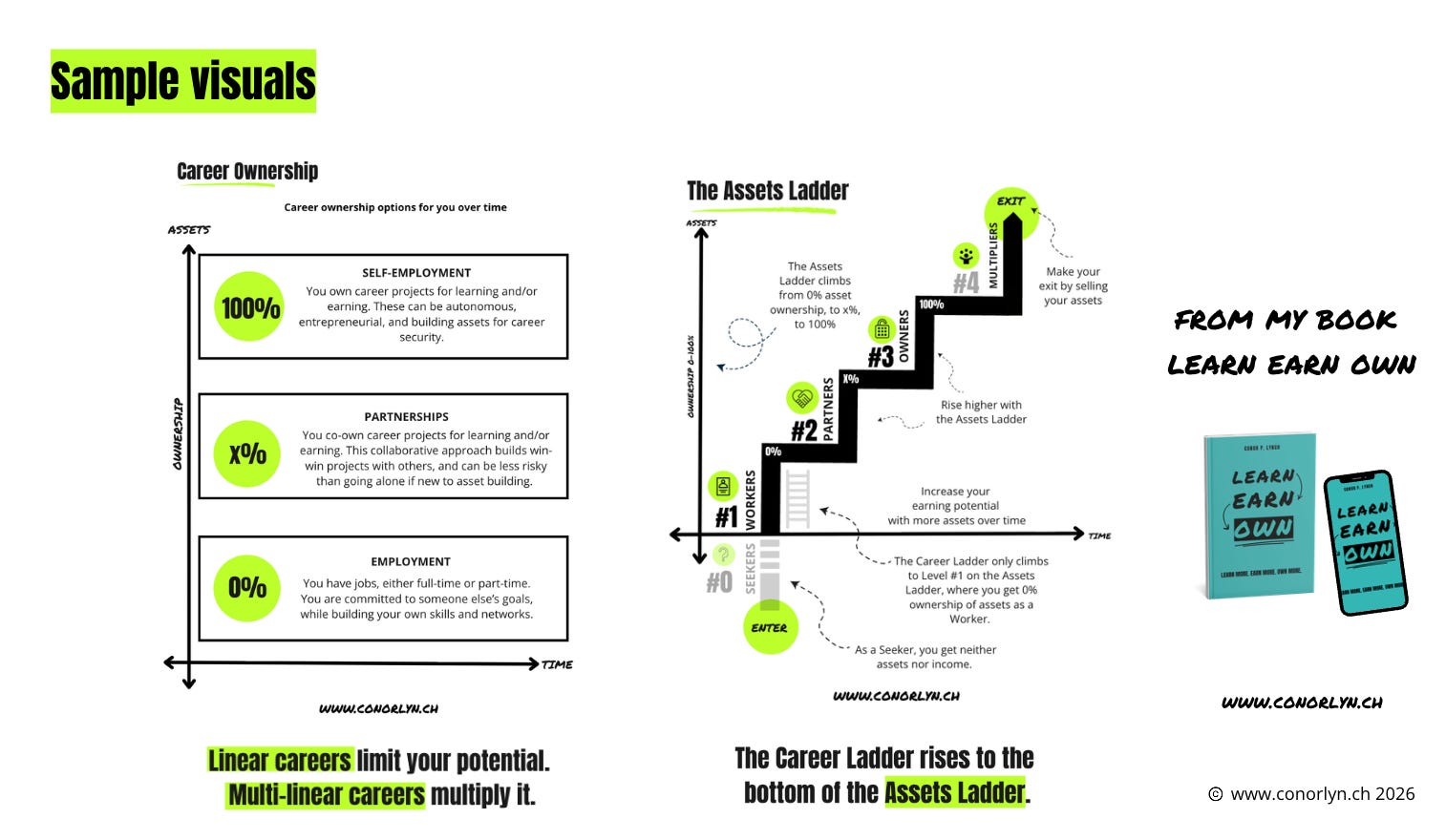
For 100 years, we were told a simple story. Study hard. Get a job. Climb the ladder. But today, the traditional Career Ladder is broken. It is broken at the bottom with a sizeable reduction in entry-level jobs. It is broken at the top for workers in their 40s, 50s, and 60s who find it hard to secure new roles comparable to previous ones. This is set against a backdrop of workers being forced to work later and later in life rather than receiving pensions.
For generations, the dominant career transaction for many has been simple: work more hours and earn more money. However, with wages stagnant and costs soaring, this is not working out as promised.
Furthermore, the Career Ladder forces you to trade time for money without building real ownership. And ‘safe’ careers are no longer safe. Careers are one of the most critical decisions a person makes, yet you were never taught how to design a career. Until now.
I talk to so many workers who are worried that relying on one employer and one income is no longer a safe bet. Most people are smart and work hard, but their rewards don’t match their efforts - they are leaving money on the table. Is the table is being taken away now too? I know this book can save you years of wasted effort and costly lost opportunities to earn thousands more over your lifetime. Or much more than that?
Technical innovations, particularly AI, are accelerating this transformation. Sam Altman of OpenAI suggests we might soon witness the emergence of billion-dollar, single-person companies - a concept unimaginable just a few years ago.

Work is undergoing a radical transformation that challenges everything we understand about work, careers, and making money. By 2034, the traditional 9-to-5 job is predicted to become extinct, with the concept of a “job for life” already consigned to the dustbin of history for most roles. Jobs are disappearing, and many people have no backup plan.
Influential thought leaders are painting a picture of a dramatic workforce evolution. LinkedIn co-founder Reid Hoffman predicts that independent workers will constitute 50% of the workforce within a decade, while the Organisation for Economic Co-operation and Development (OECD) forecasts that 50% of workers will have multiple income sources by 2035.
While many people feel trapped in the usual employment models, some escape. In 2021, the world witnessed the Great Resignation, where millions of people walked away from jobs that no longer worked for them. Headlines framed it as mass quitting, but underneath was something deeper: a collective rethinking of what work should mean.
People weren’t just resigning; they were redesigning. They sought flexibility, freedom, and ownership. Many launched side hustles, moved into freelancing, or retrained in entirely new industries. It wasn’t an end, it was a beginning.
The lesson is clear: security doesn’t come from building on rented land. It comes from building assets that create options and income on your own terms. The Great Resignation was really the first wave of a bigger shift, a move from stagnation to experimentation.

I want others to succeed much faster than I did, and this passion has led me to write this book. But I don’t want you to just read, I want you to use the tools in this book to build a better future for yourself, your friends, and your family. Although we need to take ownership of our careers, there is also an equally important recommendation to collaborate with others, despite the benefit of independence.
Ownership changes your relationship with work entirely. Instead of trading time for a fixed wage, you build something that grows in value while you sleep. It gives you leverage that a salary never can, as it gives you a position of strength rather than weakness.
From Career Ladder to Career Assets
Your career is probably your life’s biggest investment in terms of time and money. Your potential earnings with additional income streams would shock you if you did the calculations. Lost earnings compound daily, making early moves a big advantage in lifetime earnings. Time has emerged as the ultimate career currency, demanding a radical shift in how we invest it. And ownership is a career multiplier. It gives you a lot of leverage.
Early readers of this book commented that they love the practical actions and inspirational stories from those who achieved success. Their secret? They learn and earn while creating valuable assets they own. My time working on innovative digital projects and educational experiences for global brands prepared me for creating these transformational tools and templates.
Whether you’re aspiring to climb the Career Ladder, launch a side hustle, or create an entirely new career plan, the need to learn, earn, and own has never been more critical. Instead of asking “How can I find a job opportunity?”, a better question is “How can I design my career so that more opportunities come to me?” Take ownership of your career so options grow, while hours don’t.

Learn Earn Own incorporates the Assets Ladder, which is a game-changing career-mapping framework. It helps individuals visualise how learning, earning, and ownership build on one another.
The book is designed to help workers transform their prospects by owning Career Assets. These include your skills, a powerful personal brand to build your reach and reputation, digital content, digital products, your connections, portfolios, tools, code, data, and signature methodologies.
Instead of relying on one job and one employer, readers learn how to design a career that compounds over time, so they don’t get stuck, replaced, or left behind. I want to move you from dependence towards independence by generating new income streams.
Even if you have no qualifications, assets, or money, the exciting world of your very own Career Assets is only hours away at most. These elevate your work, your opportunities, and enhance your value.
I debunk the myth that assets are only for the rich and replace it with three simple steps anyone can adopt: learn more skills, earn more income, and own more assets. No matter your career stage, you can achieve more if you implement the ideas in this book. Ideas become actions, and actions become assets. Repeat.
Getting started in a career is not easy, with many working for free or for very little money to get on the Career Ladder. These work placements, internships, and apprenticeships are not ideal, with low incomes the norm. However, another way to build your own early-stage career experience is with your own Learning Projects. Even if you earn no money, you earn skills and a reputation.
The Future of Work isn’t a job. It’s a portfolio. But this isn’t about quitting employment for self-employment - it’s about not letting your job be your only plan. Jobs are temporary, assets are forever. Jobs pay, assets compound.
It’s time to ignore the old promises and wake up to a new reality. This book is perfectly timed for the rapid emergence of AI and automation, as more workers start looking for new career ideas. As AI monopolises the online world, expect a renaissance in old-fashioned ideas for the offline world. And the great thing is, you don’t need new million-dollar business ideas to run career experiments either. Just start small with micro-experiments outlined later in the book.
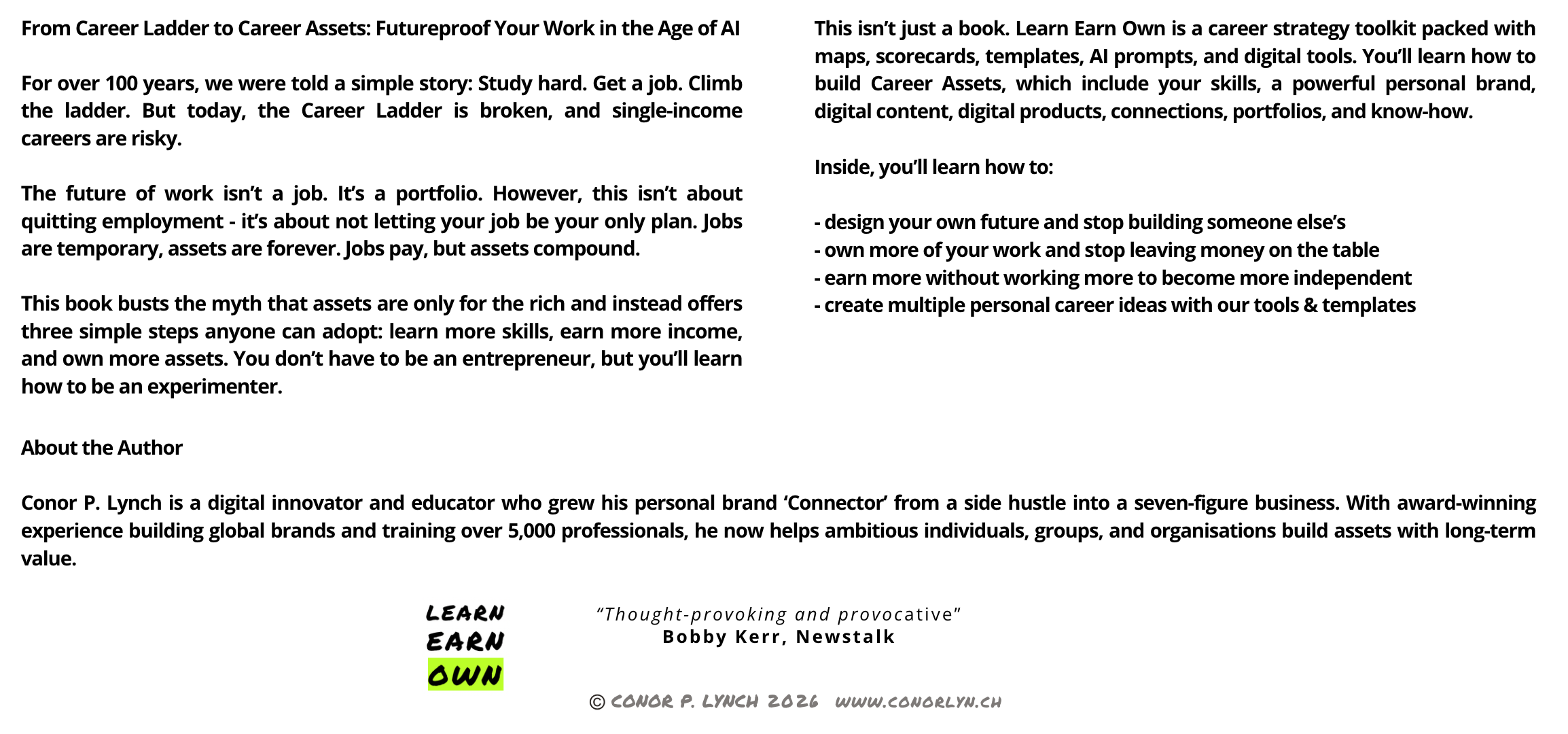
This is not just a book. It’s a career strategy toolkit packed with maps, scorecards, templates, and AI prompts. The free companion web app creates multiple personalised career paths for those who want to explore how to own more of their work.
Whether you work for others, with others, or for yourself, take ownership of your future.
Don’t settle, don’t wait, experiment today.
Learn Earn Own.

Thanks for reading this far! Please share.
Some of my media coverage is on this website, including Newstalk and The Irish Times -

Grab the paperback book and Kindle editions on Amazon
Check out my free Learn Earn Own web app here.