


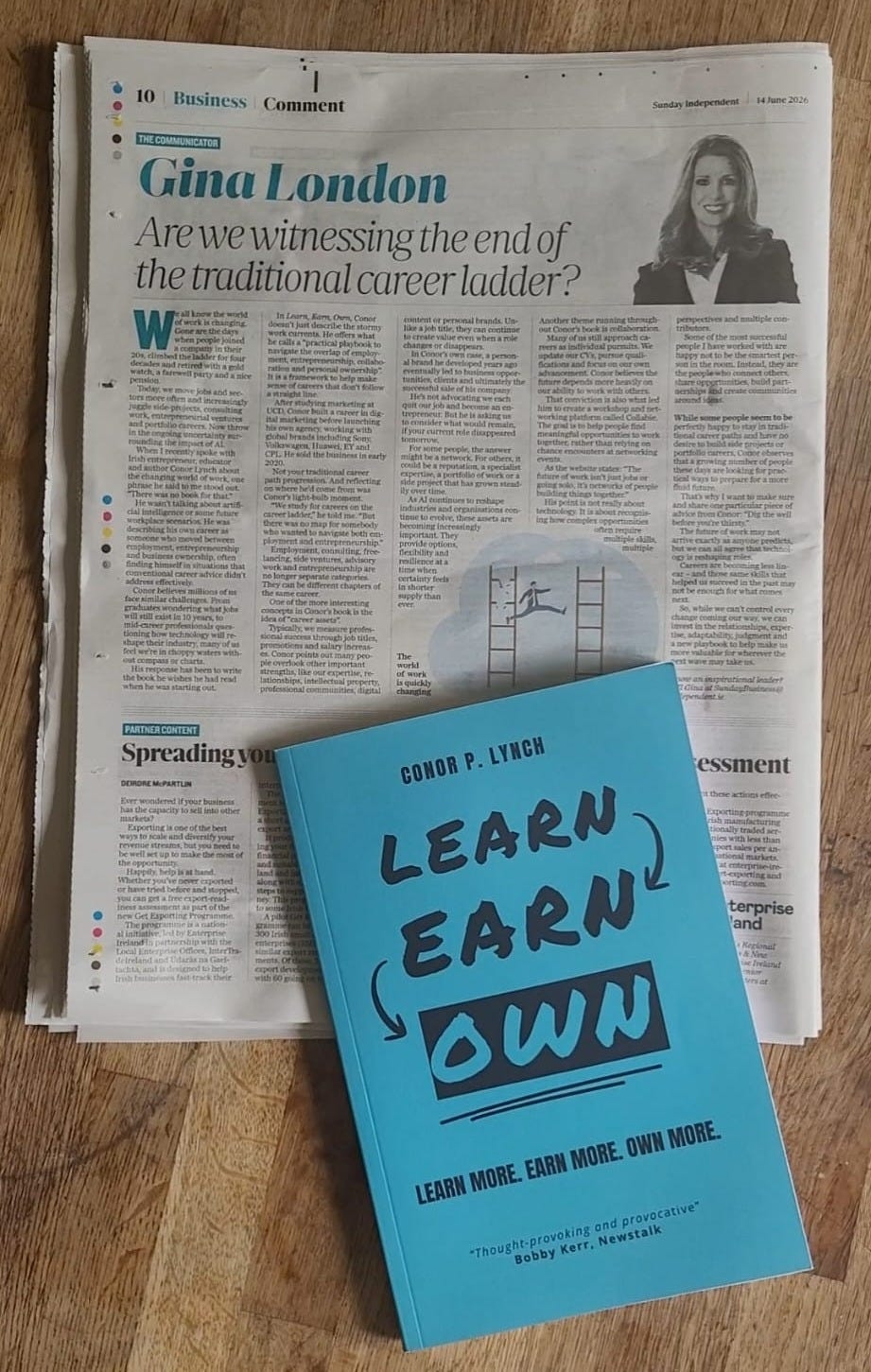
We all know the world of work is changing. Gone are the days when people joined a company in their 20s, climbed the ladder for four decades and retired with a gold watch, a farewell party and a nice pension.
Today, we move jobs and sectors more often and increasingly juggle side-projects, consulting work, entrepreneurial ventures and portfolio careers. Now throw in the ongoing uncertainty surrounding the impact of AI.
When I recently spoke with Irish entrepreneur, educator and author Conor Lynch about the changing world of work, one phrase he said to me stood out. “There was no book for that.”
He wasn’t talking about artificial intelligence or some future workplace scenarios. He was describing his own career as someone who moved between employment, entrepreneurship and business ownership, often finding himself in situations that conventional career advice didn’t address effectively.
Conor believes millions of us face similar challenges. From graduates wondering what jobs will still exist in 10 years, to mid-career professionals questioning how technology will reshape their industry, many of us feel we’re in choppy waters without compass or charts.
His response has been to write the book he wishes he had read when he was starting out.
In Learn, Earn, Own, Conor doesn’t just describe the stormy work currents. He offers what he calls a “practical playbook to navigate the overlap of employment, entrepreneurship, collaboration and personal ownership”. It is a framework to help make sense of careers that don’t follow a straight line.
After studying marketing at UCD, Conor built a career in digital marketing before launching his own agency, working with global brands including Sony, Volkswagen, Huawei, EY and CPL. He sold the business in early 2020.
Not your traditional career path progression. And reflecting on where he’d come from was Conor’s light-bulb moment.
“We study for careers on the career ladder,” he told me. “But there was no map for somebody who wanted to navigate both employment and entrepreneurship.”
Employment, consulting, freelancing, side ventures, advisory work and entrepreneurship are no longer separate categories. They can be different chapters of the same career.
One of the more interesting concepts in Conor’s book is the idea of “career assets”.
Typically, we measure professional success through job titles, promotions and salary increases. Conor points out many people overlook other important strengths, like our expertise, relationships, intellectual property, professional communities, digital content or personal brands. Unlike a job title, they can continue to create value even when a role changes or disappears.
In Conor’s own case, a personal brand he developed years ago eventually led to business opportunities, clients and ultimately the successful sale of his company.
He’s not advocating we each quit our job and become an entrepreneur. But he is asking us to consider what would remain, if your current role disappeared tomorrow.
For some people, the answer might be a network. For others, it could be a reputation, a specialist expertise, a portfolio of work or a side project that has grown steadily over time.
As AI continues to reshape industries and organisations continue to evolve, these assets are becoming increasingly important. They provide options, flexibility and resilience at a time when certainty feels in shorter supply than ever.
Another theme running throughout Conor’s book is collaboration.
Many of us still approach careers as individual pursuits. We update our CVs, pursue qualifications and focus on our own advancement. Conor believes the future depends more heavily on our ability to work with others.
That conviction is also what led him to create a workshop and networking platform called Collabie. The goal is to help people find meaningful opportunities to work together, rather than relying on chance encounters at networking events.
As the website states: “The future of work isn’t just jobs or going solo, it’s networks of people building things together.”
His point is not really about technology. It is about recognising how complex opportunities often require multiple skills, multiple perspectives and multiple contributors.
Some of the successful people I have worked with are happy not to be the smartest person in the room. Instead, they are the people who connect others, share opportunities, build partnerships and create communities around ideas.
While some people are perfectly happy to stay in traditional career paths and have no desire to build side projects or portfolio careers, Conor observes that a growing number of us are looking for practical ways to prepare for a more fluid future.
That’s why I want to make sure and share one particular piece of advice from Conor: “Dig the well before you’re thirsty.”
The future of work may not arrive exactly as anyone predicts, but we can all agree that technology is reshaping roles. Careers are becoming less linear, and the skills that helped us succeed in the past may not be enough for what comes next.
So, while we can’t control every change coming our way, we can invest in the relationships, expertise, adaptability, judgment and a new playbook to help make us more valuable for wherever the next wave may take us.
LOOK & LISTEN
Get your copy of Learn Earn Own
You can now purchase my books in eBook, black & white, or colour editions on Amazon. These books are part of the same Career Design series: ‘Learn Earn Own’ is the essential edition, while ‘The Assets Ladder’ is the professional edition.
amazon.com/author/conorlynch
